
They are really based on many properties to make these believably weird and mind bending, Optical Illusions is an old physiological property which leaves the imaginative side to the viewer to think on the situation happening in front of them. There are three main types of Optical illusions; The common ones which enable you to see another images among the image you were meant to see first after addressing thought towards the image. Physiological illusions, ones which play with the minds eye by the usage of bright and normal hues, movement of image, and tilting to find a darker side. Last but not least, Cognitive illusions which makes the brain possess unconditional and unconscious thoughts of a certain image.

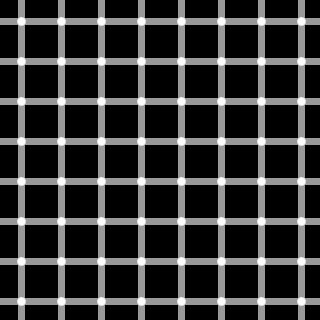 The most common, yet known quite well around the world is the Hermann Grid illusion (Example of this is the top image), founded in the early 1870's and to be first explained scientifically by Ludimar Hermann; German Physiologist. The normal, non-tampered grid, deceives the eye to believe that there is grey "phantom" squares in between the joints of the grid. But if you were to look at where these phantom grey squares were, they would disappear from sight, but still appear around the area focused on. Another grid was released during 1990's, just like Hermann's grid, but in fact is classed as a variation. This illusion was called the Scintillating grid illusion (Example is the bottom image) designed by E. Lingelbach, another German Physiologist. This illusion, which displayed the same properties as the Hermann's Grid, displayed circles at the joints of the grid instead of nothing. Doing this created an effect that, instead of squares, would appear Circles in the joints of the grid. Therefore controlling the grey phantoms into a controlled area.
 There are loads more examples of optical illusions which play around and demolish the minds own personal eye, and makes people realize or think of things which weren't so visible before. The Ponzo Illusion, created by an Italian Physiologist Mario Ponzo, shows a sign of the minds eye looking at the two parallel lines on what seems like train tracks to be one line bigger then the other. (Notice the perspective of things; one line which sits at the top looks bigger and longer then the one at the bottom.) Mario described that the average human would judge things from the background of things, and not the whole image its self. This is because the use of perspective is there and visible, what seems, train tracks trailing off into the distance which gives the effect of level, specially when the yellow line which is in two separate places are the same length, gives depth to the "object" to make it seem much larger.
 Those are a few of many examples of common usage of illusions them selves, but what about much deeper illusions? These are called Stereogram Illusions.
Stereogram Illusions;
These illusions, them selves, are known to be quite hard to view the decent amount of image in which it provides, but Stereogram's are the most hardest to take hold of, visually, but very effective in the process they're made from, this is because you must be able to either cross your eyes, unfocus them, be able to look else where from your own sight line, all sorts of practices you must enforce to see the effect the 2D image makes. These illusions inspired many to make 3D visual effects from just looking at something, such as 3D films and games, which are yet to be looked upon. There are different types of Stereograms around the globe, all found by this one man called Charles Wheatstone, an English scientist who examined peoples visual intellect and thoughts.
The few common examples of Stereograms are as follow; Stereogram imaging is when there are two images placed next to each other, seen by the naked eye, they can be spiced into four if the image is viewed in a certain way. This is technique is also used with Autostereograms, but that only uses one whole image to determine an illsion, a 3D image is meant to be seen inside the repeated images inside the one image. Anaglyph Stereogram is what used to be the old 3D visual way of the cinema's back when Jaws 3D came out into the cinemas, a green and red negative of the image is expressed onto the image its self, so when you wear special glasses, the image looks like it's coming out at you with 3D properties.

No comments:
Post a Comment
Note: only a member of this blog may post a comment.