Monday, 28 February 2011

Interactive Media and Game Design Concepts (College Work)

Media, Multimedia or Interactive Media its self has been around for many years, making big progress in employment and audience. Media could be a mixture of many things that can control artistic substances or create ability to make sure that a certain product, style, image, is placed out into the world with ease. The real meaning is basically a subject that involves different or multiple (Hence at the start of Multimedia has "Multi" on it.) content forms that appeal or proses appeal to a user or viewer. It's quite a big subject to get into, and it appeals to many who know about it as it is quite broad. Having quite a participation in actually changing the world and molding it into something which every one can deal with, or proses interest in. Biggest example of hosted media at work would be the World Wide Web. Here, it has sparked interest in many people who want to throw their opinions out into the open, and not get judged otherwise. The examples below are pieces of multimedia that have changed reality its self, as we know it. 


Web 1.0 and Web 2.0;
YouTube is now a Web 2.0 website.
During the oldest stages of web development, Web 1.0 was the serious business, and was used globally in many ways. Although, coding were completely different for browsers that let you do such things around the web, which resulted in Web 2.0 being born much later, but let us leave that explanation later. In some stages, Web 1.0 wasn't user friendly then many others believed, so it caused complications when others wanted to create their own websites and information banks but really enables users to get simple designs down and out in the open.  They hadn't have been the best graphics in the whole, not a lot of storage space was there, yet it was such a big stage in development which is more important to this day in life then you would think it would be. Connectivity was crucial to get each piece of information and data to each machine with internet access, so Web 1.0 was the circuit which would need feedback from the image of the website its self to the computer; this caused updates and developments to come much later then they would in the 2.0 forms. In Web 2.0's terms, it was the complete opposite in both information and graphic detail. The whole point of it was to be obviously better then the first, but more kind and more free to the user who is able to use such a development process in web pages. So, in simple terms, Web 1 and 2 are examples of applications used to express detail, express capability in pages and coding that goes into stations/programs such as 1.0 and 2.0. An example of a Web 1.0 website would be The Well, in which was one of the very first websites to ever be released onto the world wide web. The Well was made to test community accessibility to the internet its self, as it was released, there was such a huge amount of people who logged into it that the people who hosted the server had to make sure it was shut down entirely, to not overload the system. Google used to also be a Web 1.0 product, but has been tweaked and administrated into what is now a 2.0 website. An example of a a Web 2.0 page would be YouTube, a website which can proxy video footage and store data of personal information into their own database. This is a big leap, as it was much harder to process such detail in such a manner back when Web 1.0 coding and processing was still around; not much data was enabled for use.

Website Usability;
Thinking of the whole concept and idea of Web 1.0 and Web 2.0, usability is very important any where, especially when you want to appeal a product to certain people and to put your points and interests across. The internet is a great example of usability, as it has multiple ways to deal with certain things that it would come across. If a person had a disability, or if a person wanted help with a situation or work that they have to do, a website host and provider would have to make sure their website was updated with appealing footage and examples on their own web page. One example is a website dubbed Subtraction, a blog website that is contrasted yet stable to relate to with simple layouts and gorgeous activity. The reason this website is very good to look upon for usability is the fact of simple design and layout that it consists of. A man called Khoi Vinh was the person who created and developed this blog by him self, yet explains that the website has been his own website since the release of websites; 1997. It was basically a portfolio for him to show his less graphical work, until years went on and website development stages became apparent for him to do much more. But, because of how old the website is, Vinh him self has seen a lot of changes in web development to be able to know that there are some people out there who could be hard of hearing, eyesight troubles, or even just general public viewing are important, and it must be usable to present his work.

Example of Vinh's web-blog, Subtraction.


So, because of these two situations; Usability and Website access, situations such as console development came into play. Basing their own facts through machinery that computer products had, they come to create machines whom were able to use these sorts of accessibility and production as the World Wide Web did. 

Video Game Development and Concepts;
Games have been quite a great media product since the day it was finally introduced properly with the resemblance of Pong. Development really went on just the same as the websites own development, but with quite a twist in the graphical division. Games now had to focus on quite a few details to make their own games noticed and played, even known all across the world. The competitive side of the website now stemmed on games them selves, which resulted in different consoles being released, just like when Microsoft and Apple battled it out  and disputed for the first time, as the details of Microsoft's machinery plans were out in the open. So, games, game products and cartridges were released for different consoles that all claimed to have the best graphics, the best everything in their own department, it was and still is a huge franchise. Games have to focus on the story and graphics of their own products in which they make. They also have to make sure that their own game is quite compatible for the console its self to be able to actually play the game. These days, we are left with three major companies that service games on consoles; Sony, Microsoft and Nintendo. PC games have never been truly in the marketing feud, nor' have they been despised because of graphical terms, they have been around for ages, and the medium of the product is huge beyond compare; not all people can afford consoles them selves (Yet, computer games are not hosted on an engine which is acceptable for good quality standards, unlike the consoles which enable great quality play through. Development of consoles to be able to host such big files of data, and graphics them selves. The people who create these objects of game play and certain description in them require real life usability to example their work as "player friendly". For example, over the years, games suffered glitches and hackers all around the world, and there was no explanation as to how to stop it or who was creating hacks and why these glitches were happening. Take an 1997 example, Tomb Raider 1 was brought out for the Play Station 1, PC and the Sega Saturn, there was quite a choice in what console you were able to play such a game on, yet it experienced quite a beating when during 1998, so many glitches and unmistakable jumps that were created in game were visible, people complained of the hard detail it consisted of (It was never the most visually friendly game, either, but one of the first to have 3D game play, so it was bound to be bugged/glitched.) So, as they noted the unfortunate side of events, many games took advantage of these mistakes and managed to correct them with real life examples and events. Halo were one of the few its self,  it's much younger then Tomb Raider, but it is a good idea of how to show the change in development processes in any game. As 3D concepts came to rise up from the 2D platforms, games became more sleek and some what more pleasing to the eye and more realistic, presentation wise. 


So, all visual media products, like the internet and games them selves, rely on consumers taste to create their own pieces and to get them sold to suit everyone's needs.

Monday, 14 February 2011

Optical Illusions and Visual Effects (College Work)

Optical Illusions;
They are really based on many properties to make these believably weird and mind bending, Optical Illusions is an old physiological property which leaves the imaginative side to the viewer to think on the situation happening in front of them. There are three main types of Optical illusions; The common ones which enable you to see another images among the image you were meant to see first after addressing thought towards the image.  Physiological illusions, ones which play with the minds eye by the usage of bright and normal hues, movement of image, and tilting to find a darker side. Last but not least, Cognitive illusions which makes the brain possess unconditional and unconscious thoughts of a certain image. 


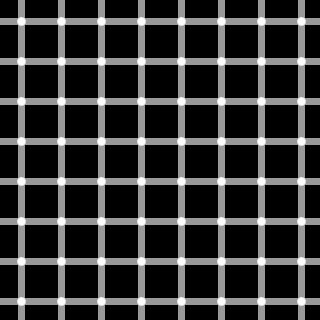
The most common, yet known quite well around the world is the Hermann Grid illusion (Example of this is the top image), founded in the early 1870's and to be first explained scientifically by 
Ludimar Hermann; German Physiologist. The normal, non-tampered grid, deceives the eye to believe that there is grey "phantom" squares in between the joints of the grid. But if you were to look at where these phantom grey squares were, they would disappear from sight, but still appear around the area focused on. Another grid was released during 1990's, just like Hermann's grid, but in fact is classed as a variation. This illusion was called the Scintillating grid illusion (Example is the bottom image) designed by E. Lingelbach, another German Physiologist. This illusion, which displayed the same properties as the Hermann's Grid, displayed circles at the joints of the grid instead of nothing. Doing this created an effect that, instead of squares, would appear Circles in the joints of the grid. Therefore controlling the grey phantoms into a controlled area. 


Gestalt Physiologists looked up to these facts as examples of ideas and plots for confusing the human eye into something believable, but also has a hidden meaning beside it all. Gestalt (Or "Shape" or "Form" as it is formally known in German) is an explanation of positive and negative space used. This usage of positive and negative space can be quite revealing if looked at for some time; making a viewer believe that there is one object, but there's another carved into the shapes. Examples of this is the Rubin's Vase, conducted and created by a man named Edgar Rubin, a Danish Physiologist. A common person would view just a standard vase or cup (Many believe it to be a cup rather then a vase); but if you look closely, you are able to see two faces eye to eye, looking at each other, or maybe a man looking at he reflection in the mirror. This is called an optical illusion because is disillusions the eye to believe one thing is there, but there is another hidden, which you really have to focus and look for.  


There are loads more examples of optical illusions which play around and demolish the minds own personal eye, and makes people realize or think of things which weren't so visible before. The Ponzo Illusion, created by an Italian Physiologist Mario Ponzo, shows a sign of the minds eye looking at the two parallel lines on what seems like train tracks to be one line bigger then the other. (Notice the perspective of things; one line which sits at the top looks bigger and longer then the one at the bottom.) Mario described that the average human would judge things from the background of things, and not the whole image its self. This is because the use of perspective is there and visible, what seems, train tracks trailing off into the distance which gives the effect of level, specially when the yellow line which is in two separate places are the same length, gives depth to the "object" to make it seem much larger. 


Those are a few of many examples of common usage of illusions them selves, but what about much deeper illusions? These are called Stereogram Illusions.

Stereogram Illusions;
These illusions, them selves, are known to be quite hard to view the decent amount of image in which it provides, but Stereogram's are the most hardest to take hold of, visually, but very effective in the process they're made from, this is because you must be able to either cross your eyes, unfocus them, be able to look else where from your own sight line, all sorts of practices you must enforce to see the effect the 2D image makes. These illusions inspired many to make 3D visual effects from just looking at something, such as 3D films and games, which are yet to be looked upon. There are different types of Stereograms around the globe, all found by this one man called Charles Wheatstone, an English scientist who examined peoples visual intellect and thoughts. 
The few common examples of Stereograms are as follow; Stereogram imaging is when there are two images placed next to each other, seen by the naked eye, they can be spiced into four if the image is viewed in a certain way. This is technique is also used with Autostereograms, but that only uses one whole image to determine an illsion, a 3D image is meant to be seen inside the repeated images inside the one image. Anaglyph Stereogram is what used to be the old 3D visual way of the cinema's back when Jaws 3D came out into the cinemas, a green and red negative of the image is expressed onto the image its self, so when you wear special glasses, the image looks like it's coming out at you with 3D properties. 

Friday, 11 February 2011

Interactive Comic Research (College Work)

Graphic Novels, also known as Comic Novels, have been around for centuries and are often confused as the common Picture Books in which kids (and of course adults) happen to read. Comics really influence the reader in the way the panels and characters are presented in such a way which is understandable with the current obligation or happening in a certain scene. Progression and possessive noticing of graphic novels started off in the late 19th early 20th century, where comic artists or people with ideas of animation (interactivity) were adding objects and text together, as if they were in conversation, talking to each other. This idea, image and perspective of how this art was produced sprouted interest all over the globe, with new ideas and exiting experiments. Things such as this happened before hand (during the 17th and 18th century), but never really progressed into something people really understood. It became a great way to spice up advertisement, though. It was like reading some one else's/characters thoughts on a product, reflecting it back onto your self. Idolisation was a key thing in advertisement; this lead to individual character designs and development through the booming years. Experiments with both real life models and cartoon related models were used back in the day, and even in the current state, we still use both today. 


Interactive Comics, or Interactive Graphic Novels, are similar to most regular Graphic Novels you would see in the shops or news paper. Although, being interactive with something usually means you have to get into the act of the Comics own personal story. Whether it's an animation or a scene where you have to flick the page, move an object, or slash a demon; these are the qualities in which Interactive Comics provide. People mistake it for animation clip or a movie clip, which it is! It needs interactivity from the reader for an animation or happening to occur during a scene, to change position. Or they mistake it as a game, which it could be as challenging, if you believe it to be so. Many things Interactive Comics really could be mistaken for, but there is one thing in particular in which Interactive Comics have; a unique ability to draw the reader in and be one with the whole situation all together.


Examples and Reviews of Interactive Comics;
Comic Volt IC
 (Click here for Website)


In my own personal view, Comic Volt has really outdone themselves with the whole introduction scenes and page turning additions (Pages are spread out at the bottom of the current viewed page). I like the playful design and style of characters, giving them individuality through out each page. There is different stories (Hence the name "Comic Volt", which could suggest "Many Comics" stored inside one place.), each comic spread, which lead you to a cliff hanger for your own imagination to process and make up a scenario that'd happen next. The unfortunate side is this comic hasn't been updated enough to say this is the case, or there would be a sequel to the before comic. The reason could be that the comic is very deeply coded and would take a while for an update to be released or that the designers and artists are busy, what this comic lacks is an update or news area. For the interactivity side, this comic gives enough but it's just making things turn to the next page, clicking on hot spots on the main page and viewing introductions. It's boring and less productive of what it could be. Overall, it's a great and beautifully composed attempt of a gorgeous comic just lacking in the interactive department.


 Dead on Arrival
(Click here for Website)


Dead on Arrival is a deep set comic, with such an intense story which will surely get you on the edge of your seat. The story is about Teacher wanting to up his position in the department, but before entering the office of his own boss, he can hear interaction with his bosses own secretary. Bursting in, the man protagonist dubbed David, uses this as a threat as his boss refuses to land a raise in position. David explains will go as far as to get the man in charge in trouble, knowing full well of his bosses wife's parents, threatens to tell on his boss. As the story goes on, David happens to drink radioactive coffee, which would frankly cost his life. Your objective is to think of who did it and select the culprit, and carry on from there. This comic is very flexible and very understandable, simple and smart. Story wise, it is beautifully designed and is quite catchy, even if it's quite corny as you go through the panels, corniness just adds to the individuality this comic truly has. The effect of using real life models and pursuing to add texture and contrast to make it look like it's a real comic book, I really like this and the whole idea of Dead on Arrival's storyline and layout. The thing I really dislike is the shortness of the story, and not a clear understanding of what you have to do some times, or what the icons and symbol means on the flash page. Updates are not needed for Dead on Arrival as it is just one story, although it could have been carried on, or have different outcomes to the story to make it more interesting and much longer.

NAWLZ
 (Click here for Website)


I have never experienced such a complicated comic as Nawlz. Nawlz is the most favorite out of the three I have looked upon, and I adore the scribbly style of the gorgeous artwork presented in this interactive comic. The story starts off with a man who believes what ever he imagines comes to life in a blink of an eye, but not in front of him, but over time, it's created in another place as a figure, like he's in a dream. Although, the mind of the main character is represented or hosted by a puffer fish, which explains what is clearly happening, and what will go on. I like the overall idea of this comic, in general, and there's hardly nothing to criticise on. The speech is rarely in classic speech bubbles, but in (what seems) as coded text, processing the thoughts and mind of the main character. Interactivity is very heavy, enabling you to over over and experience thoughts or clues to certain things in Nawlz that happens. The characterisation and art is very steam punk; very rough and sharp, and quite pleasing to the eye. There are few colours used (Normally monochrome and slight spectrum appearances.) The comic is updated quite frequently, with brain busting new stories and adventures. The downside is the cluttered effect of the whole comic. It's beautiful to see for many, and it's very nice to experience, but it can be complicated where you can find and carry on with the story with a click of a button.

Monday, 7 February 2011

Ways of Advertising, Publicity and Propaganda (College Work)

Advertisement;

Advertisement has been a spectacle for many years (ever since the 1913's where it became quite big during WWI, but has been around during 4000 BC, introduced by Egyptians), gifting its messages to the readers, which is the people. It is used to place a point across, making things simpler and more visual communicated for us to understand, without blocks of text explaining certain points to us. Advertisement is important, and really rules our lives, even if you think it doesn't. How else do item products, telephone numbers to your favorite restaurant, or maybe placing a personal message across (eg. Child Abuse). Adverts give and create an effect in your mind, never truly forgotten, but we toy with it in our minds, and effects us. Although, times change, generations focus on a different interest and idea which really is experienced all around the world. World change of ideas is the biggest issue in the advertising market, so advertisers make sure they keep their research up-to-date by being able to appeal to a certain generation.


Examples of Image Advertisement;

Advertising the Medicine BRIM

This image really gives a powerful expression and impression on any one. In this image, the bat tries to break the Vase with the flowers, but it can also represent a person who has taken the medicine, and the virus is imitated by the bat. This shows how, the advertisement claims, strong the medicine is and how effective it can be. But this also could have hidden meanings as well as the true meaning it possesses.


Advertising the Postal Service "Post" or meaning of Letters


The meaning of this advertisement is really hard to find at first; You could suggest it shows how much stories draw people in to read more. Instead it is about how writing a letter to some one is just as meaningful and wonderful as meeting and greeting a person in real life. By the person (Or the figure, symbolising the calm and collective words of the "Letter") hugging the woman, this indicates the closeness it could get to some ones "Heart".


Advertising a Funeral Service

This image is quite simple, yet very effective in the way it's positioned. Putting forward the meaning of a Funeral service but how quick death can be, or how damaging, almost tempting you to be in the same position as the deceased, "Come a little closer" expressed on a train track. It's pretty hard to tell what point this service is trying to put across, wanting to "come closer" to a danger zone, but it can also warn off people in a sense it's not a good idea to do.


Advertisement for wastage of Money

The way this advert was produced was very clear on putting across a reason or design, specially with the speculation of money. There were rumors about this advertisement using fake printed money to plaster the sides of the billboard, many tried taking the money as well. This advertisement could be showing many ideas or reasons, but others believe that this was to show how much we waste money, just throwing it away and clearly using it as "wallpaper". 


Examples of Video Media Advertisement;

Advertising Reebok Trainers "Loose your belly" 

This advert gives you something to laugh about, proving a great point about running as well. Having this "belly" chasing after a guy indicates that if you use Reebok's trainers you will loose/outrun that "belly" or, in this case, your own belly as you comfortably exercise it out with your new Reebok trainers you may buy because of this advert. Another way you can look at this advert is how far and long this man is traveling, durance is something which comes up quite a lot here, showing how long you can last.


Advertising delicious Doritos

A dog which is running towards a man with food in his hand, even if there's a door in front of it, nothing is stopping it from capturing and eating the Doritos which the man is teasing the dog with, in his hand. This show "interest" or the taste of the Doritos are so great, you will do nothing to get them. The slow motion capturing and experience this advertisement gives really gives you a tense feeling; is the dog going to smack into the door or smash through, hooking you into the moment.


Advertising Sony Bravia TV's

This advertisement shows quality in this product, or what this product can do. "Magical", it says to people, but also the colour and depth of what is really happening in each scene. The experience it brings at first glance is; "What is this advert about?" And at the end, explaining it is a Sony related TV product. It shows how much quality and time goes into each machine, expressing their detail.


Advertising the fun usage of the Xbox 360 console

As they all pull out their fake guns, you can tell, everyone around is very into the shooting "game". (Yet, when each person gets shot, it looks like a real life reaction of when some one regularly gets shot.) This gives a powerful image, a feeling that you are really in a game, that you're in there, and can feel the emotions and pains of a character. This is one way to think of how this advert is putting its point across; Xbox 360 gets you hooked and interested deeply in the game.


Propaganda;

Propaganda is always in unison with Advertisement, but in a much more meaningful scale, delivering more of an explained approach, telling you what is what in a harsh influencing manner. Unlike Advertisements, Propaganda is influencing the real world with ideas and attitudes, to encourage a wide range audience but taking on board no one else's opinion. Adverts focus on the peoples view on something, as Propaganda believes in something different; Just like artwork, it will always have a hidden meaning of what the person was thinking of, other then the meaning you truly believe in. 
Because of self opinion in Propaganda exploitations, lies can be made to intimidate a person to believe different. These could be used in a wide range scale; world wide maybe. 


Examples of Image Propaganda;

Propaganda for Woman to take part in Expanding Britain

This was posted around the streets of Britain during the Second World War (WWII) to show how working in the factories will help create and help win the world war with ease if more people show their input to their own country. Woman were advised not to take part in the war its self because Male Conscription was introduced to ensure men were there, willing to fight. So, to expect and feel their safety, "desk jobs" were issued for them. 


 Propaganda for the fear of German Nazi Spies

Speaking out loud of plans or gatherings which were taking place in your area could cause damage to the country its self, resulting in them all loosing the war all together against Nazi Germany. During World War One, using careless talk and explaining about the happenings and plans of your own country happened a lot, causing more deaths then ever imagined. Paranoia came about during the second, making it harder for German Nazi spies to interrogate and fish out ideas and schemes.


Propaganda for the dangers of War Time Hazards

During both World War One and Two, Propagandists and the countries wanted to make sure the country was fit and able to manage them selves through the dangerous times, by giving out words of advice and warning. One of the main cautions people were to look out for was the Blackouts. Blackouts were used as a sign of secrecy or because explosives or tampering has left lights locked down. 


Propaganda for the battle to keep Briton, Briton

Moving away from the world wars now, discussing the temptations of today to keep the country stable, Britain suffered huge job losses and lack of housing due to apparent "immigrants" moving into the country for refuge from their own country. BNP or the British National Party picked up on this, and spoke out for the Brit's who were worried for their own children finding a place for them selves and to not having to learn different currency and politics all together.